


This guide is for Cardiff homeowners who are planning a renovation and want a solid wood floor fitted properly, in a way that respects the age of their home rather than fighting against it. We cover the floor types that suit older properties, the finishes that work with natural light and period proportions, and the practical considerations that matter when fitting solid wood flooring into a building that was put up more than a century ago.
Why Period Properties Need a Different Approach to Solid Wood Floor Fitting
Older homes were built differently. Subfloors are often made from original timber joists rather than concrete, which means they move with the seasons in a way that modern substrates do not. Solid wood floor fitting carried out on top of a springy Victorian subfloor without proper preparation will result in a floor that creaks, gaps, and fails prematurely.
There are also proportional considerations. A wide-plank board that looks striking in a contemporary open-plan space can feel mismatched in a room with a twelve-foot ceiling, a cast iron fireplace, and picture rails. Equally, intricate parquet laid in a small Edwardian hallway can feel overwhelming if the scale of each block is not considered relative to the floor area.
Period properties also tend to have irregular levels between rooms, original thresholds, and door frames that have settled over decades. Solid wood floor fitting in this context needs a specialist who will survey the subfloor, account for these variables, and recommend a fitting method and floor type that will perform over the long term rather than look good for a season and deteriorate.
Wood Flooring Specialist, based just outside Cardiff, handles assessments of this kind as a dedicated part of the service. Every survey is carried out personally, drawing on hands-on technical knowledge rather than delegated to a generalist fitter.
Choosing a Floor Type Before Fitting Type
The most sympathetic choices for Cardiff’s stock of period homes fall into three broad categories, and the right choice will shape the whole approach to solid wood floor fitting.
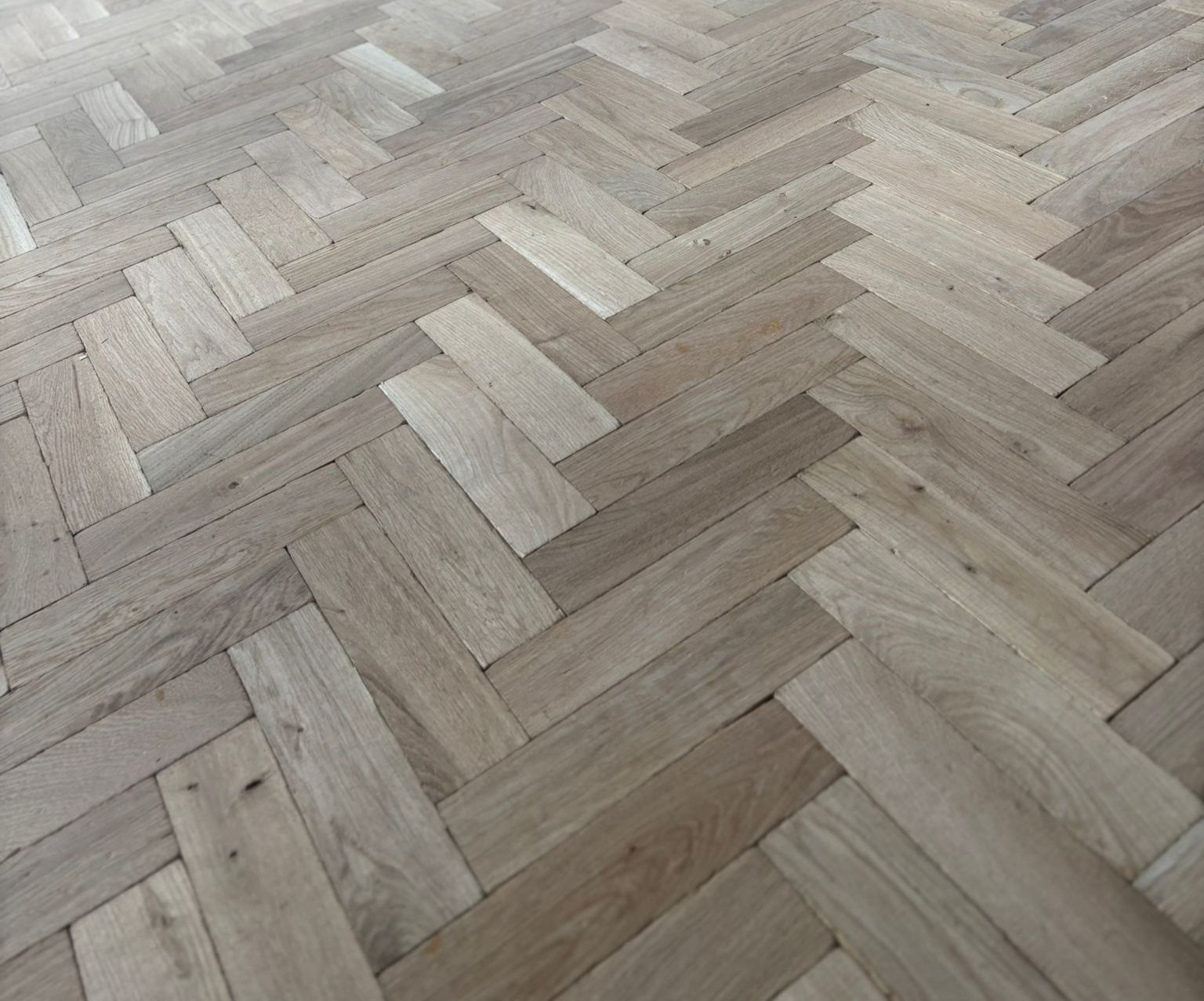
Parquet is arguably the most historically appropriate option for Victorian and Edwardian properties. Block parquet was common in grander homes of the late nineteenth and early twentieth centuries, and reclaimed parquet salvaged from period buildings carries a patina that is genuinely of the era. Tumbled oak parquet, laid in a traditional herringbone or brick-bond pattern, reads as authentic in a Roath terrace without looking like a reproduction.
Plank flooring in a narrower width, typically between 90mm and 120mm, suits the proportions of most Cardiff period rooms better than the wider planks associated with contemporary interiors. European oak in an unfinished state, hand-finished on site with oils or lacquers once fitting is complete, allows the grain and natural colour variation to sit naturally alongside aged plaster walls and original woodwork.
Chevron is a more formal pattern and works particularly well in hallways, reception rooms, and larger kitchen diners where there is enough floor area to allow the geometry to read clearly. In smaller rooms it can feel busy, so the floor area should be assessed before committing to this pattern.
For homeowners with original floorboards that are structurally sound but worn, restoration is often the most sympathetic route rather than a full re-fit. Sanding back to bare timber and applying a hand-finished stain, oil, or lacquer preserves the original material and the history embedded in it.
Matching Finishes to Period Features Type
The finish applied after solid wood floor fitting will do more than protect the timber. It will determine how the floor sits alongside skirting boards, dado rails, cornicing, and original joinery, so it deserves as much consideration as the floor type itself.
Oiled finishes tend to produce a flatter, more natural sheen that sits well in rooms with aged plaster and unpainted original features. They allow the wood to breathe and, in a period property where humidity varies between rooms and seasons, this can reduce the risk of surface cracking.
Lacquers and hard wax oils produce a more durable surface and can be built up in layers to achieve anything from a very low sheen to a polished finish. In a working family home where the period features are decorative rather than deliberately rustic, a harder finish often makes more practical sense.
Stain choices are where the floor connects most directly to the colour palette of the room. A warm, mid-brown stain reads sympathetically against original pine joinery and red-brick fireplaces. Cooler, greyer tones can work in rooms that have been redecorated in contemporary neutrals while retaining original mouldings. Matching the stain precisely to existing joinery is possible with a bespoke mixing service, which is an approach worth discussing during a pre-installation consultation.
Hand-finishing on site after fitting, rather than buying a pre-finished board, allows this level of bespoke colour matching. Every plank is treated once solid wood floor fitting is complete, which means the finish wraps into the joints and around the room’s fixed elements rather than stopping abruptly where pre-finished boards meet the skirting.
Practical Considerations Before Fitting Begins
Before any solid wood floor fitting takes place in a period property, the subfloor needs to be assessed properly. In a Victorian or Edwardian terrace, that typically means checking for:
Joist condition and any localised rot or movement that needs addressing before fitting begins. A floor laid on a failing joist structure will not perform regardless of the quality of the timber above it.
Moisture levels. Older homes can carry higher moisture in the subfloor than newer builds, particularly in ground floor rooms with suspended timber rather than concrete. Timber that is not properly acclimatised to the ambient conditions in the property before fitting can expand or contract significantly once laid.
Level variations between rooms. A period home will rarely have perfectly flat floors between doorways, and thresholds and transitions need to be planned carefully so the finished result is tidy rather than a trip hazard.
A pre-installation survey resolves all of these questions before any timber is ordered. Wood Flooring Specialist offers independent surveys and pre-installation assessments as a standalone service, which means a homeowner can get a detailed, impartial view of their subfloor condition and the most appropriate fitting method before committing to a product.
Acclimatisation of the timber once it arrives on site is a step that is sometimes skipped on faster jobs but matters considerably in older buildings with variable temperature and humidity. Allowing boards or blocks to sit in the room for the recommended period before fitting reduces the risk of gapping or cupping once the floor is in use.
Restoration as an Alternative to Fitting Type
Not every period property renovation requires solid wood floor fitting from scratch. If the original floorboards or parquet are structurally sound, restoration can be the better choice on both practical and aesthetic grounds.
Original Victorian and Edwardian floorboards are typically wider than modern equivalents and made from slow-grown timber with a tighter grain. When sanded back and properly finished, they take on a quality that is genuinely difficult to replicate with newly fitted material. The floor also carries the natural variation that comes from a century of use, and many period homeowners prefer this to a uniform, freshly fitted product.
Parquet blocks, similarly, can often be lifted, cleaned, and re-laid rather than removed and refitted entirely. Damaged or missing blocks can frequently be sourced from reclaimed suppliers to maintain the continuity of the pattern.
Dust-free sanding is particularly relevant in a period property where the rooms are occupied or adjoining living spaces contain period fixtures and fittings that are difficult to protect. A dust-free service minimises the spread of fine particles through the property during restoration, which reduces disruption and the cleaning work required afterwards.
The decision between restoration and new solid wood floor fitting is best made after a survey, because the structural condition of the existing floor will determine whether restoration is viable or whether the subfloor issues underneath need to be resolved first.
Working with a Solid Wood Floor Fitting Specialist in Cardiff
Cardiff’s period housing stock is concentrated in specific neighbourhoods, and each area has its own characteristics. The terraces of Roath and Roath Park tend to be tightly proportioned Victorian and Edwardian homes where hallways and front rooms are the priority spaces. Pontcanna and Pontcanna Fields carry a higher proportion of larger Edwardian and interwar semis where original parquet or board floors are more commonly found in good condition. Canton, Cathays, and Penylan each have their own character, and the approach to solid wood floor fitting that works in one street does not automatically transfer to the next.
Working with a specialist who knows the Cardiff housing stock, rather than a generalist fitter applying a standard specification, makes a practical difference at every stage from survey through to the finished result.
Wood Flooring Specialist supplies and fits bespoke solid wood flooring and carries out restoration and finishing work across Cardiff and the surrounding areas. Every project is handled personally, and the range of finishes, stains, varnishes, lacquers, and oils available means the floor can be matched precisely to the property rather than selected from a limited palette.
If you are planning a renovation and want to talk through solid wood floor fitting options for your period property, an initial consultation or survey is the practical starting point. Use the enquiry form to get in touch and describe your property and what you are looking to achieve.
FAQ’S
What type of solid wood floor fitting is most suitable for a Victorian terrace in Cardiff?
Parquet and narrower-plank solid or engineered oak boards tend to suit the proportions of Victorian terraces best. Traditional block parquet laid in a herringbone pattern is historically appropriate and works well in hallways and reception rooms. For rooms with irregular subfloors or higher moisture levels, an engineered construction can offer greater stability while still allowing a hand-applied, bespoke finish on site.
Can original floorboards in an Edwardian home be restored rather than replaced with new solid wood floor fitting?
In many cases, yes. Original Edwardian boards are often made from slow-grown pine with a tighter grain than modern equivalents, and when they are structurally sound they can be sanded back and refinished to a very high standard. A pre-installation survey will confirm whether the boards and the subfloor structure beneath them are in suitable condition for restoration or whether new fitting is the more practical route.
How do I match a finish to original joinery after solid wood floor fitting?
The most reliable approach is to have the finish mixed and applied on site after fitting rather than buying a pre-finished board. This allows the stain and sheen level to be adjusted to sit alongside the specific colour and tone of your existing joinery, skirting, and architraves. A bespoke hand-finished floor can be matched far more precisely than any off-the-shelf product.
What is dust-free sanding and why does it matter in a period property?
Dust-free sanding uses specialist equipment that captures the fine particles produced during floor sanding before they spread through the property. In a period home this is particularly useful because original plasterwork, cornicing, fitted furniture, and decorative features are difficult to protect from fine dust. The service significantly reduces disruption during restoration work and cuts the cleaning required once the job is complete.
Do I need a survey before solid wood floor fitting in an older Cardiff home?
A pre-installation survey is strongly advisable for any period property. Older homes frequently have subfloor conditions that differ from modern builds, including suspended timber joists, variable moisture levels, and uneven transitions between rooms. A survey identifies these issues before any timber is ordered, which avoids problems with the finished floor and ensures the fitting method chosen is appropriate for the specific conditions in your home.
How long does solid wood floor fitting take in a period property?
Timescales vary depending on the floor area, the product chosen, and the condition of the subfloor. Any subfloor preparation work will add time, as will the acclimatisation period for the timber once it arrives on site. A hand-applied finish also requires time between coats. A realistic project timeline will be confirmed during the pre-installation consultation once the scope of the work is understood.
